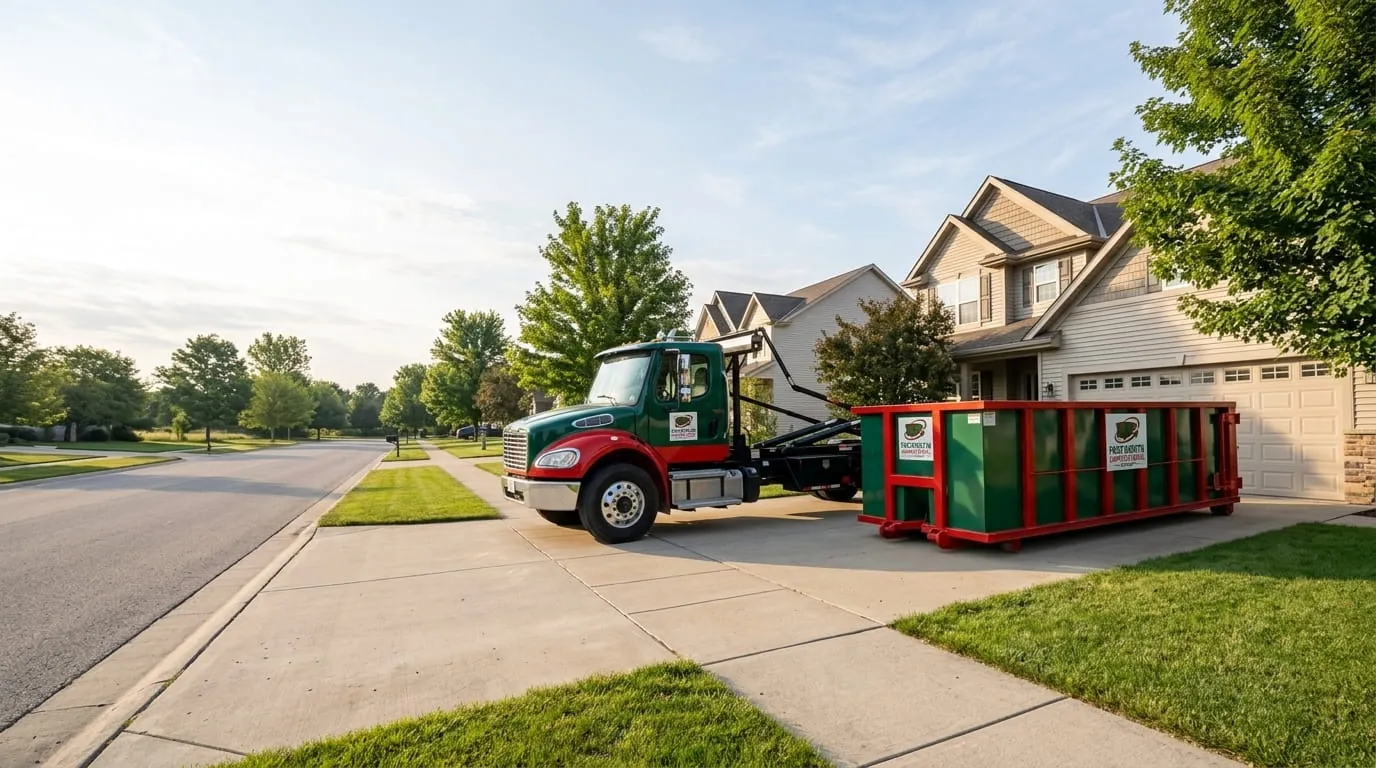
If you are planning a renovation, a garage cleanout, a roofing job, or a move here in Portsmouth, one of the first logistical questions that comes up is where the dumpster is going to sit and whether you need the city's permission to put it there. It is a smart question to ask, and the honest answer is: it depends almost entirely on where the container lands. In most cases around Portsmouth, a roll-off dumpster placed on your own private driveway or property needs no permit at all. The moment that container has to sit on a public street, curb lane, or city right-of-way, though, you are generally looking at a City of Portsmouth right-of-way or encroachment permit. This guide walks you through the difference, who is responsible for the paperwork, and how our team keeps most Portsmouth jobs on private property so the permit question never comes up in the first place.
The short answer: driveway versus street
Think of it as two separate scenarios. The first is placement entirely on land you own or control, which covers the overwhelming majority of residential rentals. The second is placement on anything the public owns, which is where city rules kick in.
- Private driveway or private property — usually no permit. If the dumpster sits on your own driveway, a parking pad, a side yard, or a commercial lot you control, you typically do not need a permit from the City of Portsmouth. You are using your own space, so the city is not involved.
- Public street, curb lane, or right-of-way — permit usually required. If the only practical spot is the street in front of your home or business, or any portion of the public right-of-way, the city generally expects that placement to be permitted. Portsmouth, like most Hampton Roads localities, treats the paved travel lane and the strip between the sidewalk and curb as public space that is managed, not open for anyone to occupy with a large container.
That second category is where people get tripped up, because the right-of-way often extends several feet beyond the curb and can include the area where you might instinctively think is "your" front yard. When in doubt, assume the street side needs a closer look.
Why Portsmouth is a city matter, not a county one
One detail that confuses newcomers and even longtime residents: Portsmouth is an independent city in Virginia. It is not part of a surrounding county the way towns in many other states are. That means there is no county permit office to call for a street placement — the right-of-way, the streets, and the encroachment rules are all administered by the City of Portsmouth directly. When you need a permit to place a dumpster in the public right-of-way, you are dealing with city hall and the relevant city department, not a county seat somewhere else.
This is actually simpler in one respect: there is a single local authority to work with. But it also means you should not rely on advice written for a county-based area, because the process, the forms, and the department names will be specific to Portsmouth. Specifics such as exact fees, the precise department handling the application, and turnaround times do change from time to time, so we always recommend confirming the current requirements directly with the City of Portsmouth. Our team stays current on how these placements are handled and we are happy to help you coordinate the process when a street placement is unavoidable.
Who actually pulls the permit?
This varies, and it is worth sorting out up front so nothing stalls on delivery day. In some cases the property owner or contractor applies for the right-of-way permit because they are the party responsible for the project and the site. In other cases the rental company assists or applies on the customer's behalf. There is no single universal rule, which is exactly why we talk it through with every customer who is looking at a street placement.
What we do at Portsmouth Dumpster Rental Group is straightforward: before we ever schedule a drop, we figure out where the container is going. If it is going on your driveway, there is nothing to file. If it has to go on the street, we help you understand what the City of Portsmouth currently requires, who needs to submit the application, and what information they will ask for. We would rather spend ten minutes on the phone sorting this out than have a truck show up to a spot that is not cleared for placement.
Timeline expectations
If a street permit is needed, build in some lead time. City permit processing is not instant, and you do not want to find out the day before your project starts that the application still needs review. As a general rule, give yourself several business days of cushion rather than assuming same-day approval. We cannot promise a specific turnaround because the city sets that, and it can shift with workload and season — so the safe move is to start the conversation early. When you call us to book, mention right away if street placement is likely, and we will help you get the ball rolling on the city side so the paperwork and the delivery line up.
Olde Towne and the historic core: where street placement is more common
Portsmouth's Olde Towne is one of the oldest and most walkable neighborhoods in Hampton Roads, and it is also where the permit question comes up most often. The historic streets are tight, many of the homes sit close to the road with short or narrow driveways — or no driveway at all — and on-street parking is already at a premium. For a renovation on an Olde Towne rowhouse or a historic single-family home, there is sometimes simply no room on the property for a roll-off container, which means the street becomes the only realistic option.
In these situations, a right-of-way permit is often part of the picture, and placement has to be handled thoughtfully so you are not blocking a travel lane, a neighbor's access, or a corner sightline. There can also be additional sensitivity in historic districts about how long a container sits out and how it is positioned. We have worked these narrow streets before, and we plan the drop and pickup to keep disruption to a minimum. If you own property in Olde Towne, Port Norfolk, Park View, or one of the other older close-in neighborhoods, assume we will want to talk through placement carefully before we schedule.
Churchland, Western Branch, and the newer subdivisions: driveways make it easy
Head across to the Churchland and Western Branch side of the city and the picture changes almost completely. The subdivisions out there were built with cars in mind, which means wider driveways, longer approaches, and more room to maneuver. For most homes in these neighborhoods, a roll-off dumpster fits comfortably on the driveway with space to spare, and that means no street placement and no city permit. This is the easy scenario, and it is the one we aim for whenever we can.
A wide driveway does come with one thing to protect: the surface itself. A loaded roll-off is heavy, and you want boards under the container's rails to spread the weight and avoid marking the concrete or asphalt. We cover exactly how we protect your driveway in our guide to protecting your driveway during a dumpster rental, and it is a standard part of how we place every container. For a quick overview of what residential placement looks like start to finish, see our residential dumpster rental page.
HOA rules in newer subdivisions
Here is the twist that surprises a lot of homeowners: even when the city does not require a permit because your dumpster is on your own driveway, your homeowners association might still have something to say about it. Many of the newer Portsmouth subdivisions in Western Branch and the Churchland corridor are governed by an HOA, and those associations frequently have their own rules about how long a container can sit out, where it can be placed, whether it needs to be screened from the street, and sometimes whether you need to notify the board in advance.
An HOA rule is separate from and in addition to any city requirement. The city might not care about a driveway placement at all, while your HOA covenant sets a limit of, say, a certain number of days or requires the bin to sit behind a gate. Because every association's documents are different, we cannot tell you what yours says — you will want to check your HOA's covenants, conditions, and restrictions, or send a quick note to your board or property manager before the container arrives. Doing that one check up front saves a lot of friction later.
Placement and marking: doing it right wherever the bin sits
Whether the dumpster is on your driveway or, with a permit, on the street, good placement practice matters for safety and for staying on the right side of the rules. A few things we pay attention to on every Portsmouth drop:
- Clear access and sightlines. The container should never block a sidewalk in a way that forces pedestrians into traffic, obscure a driver's view at a corner, or sit over a storm drain, a water meter, or a utility access point.
- Visibility for street placements. When a container is permitted on the street, it needs to be visible to traffic. That can mean reflective markers or cones so drivers see it clearly at night, especially on the narrow streets around the historic core.
- Protecting the surface. On driveways we use boards under the rails to protect concrete, pavers, and asphalt from the container's weight and from scratching during drop and pickup.
- Room to service it. The truck needs a clear, straight approach to set the bin down and lift it back up. We check overhead clearance for low branches and wires too, which matters on older tree-lined Portsmouth streets.
How our team avoids needing a street permit where possible
Our default goal on every job is to keep the container on private property so you never have to deal with a city permit at all. We do that a few ways. First, we talk through the site before we book — a quick description of your driveway, or a photo texted over, usually tells us whether the bin will fit. Second, we match the dumpster size to the space; a slightly smaller roll-off that fits the driveway is almost always better than a larger one that forces a street placement. You can see the range of containers we carry on our roll-off dumpster rental page. Third, we position for the truck's approach ahead of time so we are not improvising on delivery day.
When street placement genuinely is the only option — which happens most in Olde Towne and the tightest older lots — we do not just leave you to figure out the city process alone. We help you understand what the City of Portsmouth currently requires and help coordinate so the permit and the delivery are lined up. Either way, you get a placement that is legal, safe, and planned, not a scramble.
What about cost?
Permit considerations are one piece of the overall picture, and street-placement permits, where required, are a separate city charge from the rental itself. We never quote you a made-up city fee, because those are set by the City of Portsmouth and can change — we point you to the city for the current figure. For a breakdown of what goes into the rental price and how to budget for your project, take a look at our guide to dumpster rental cost in Portsmouth. And if you just want a straight answer for your specific address and project, the fastest path is to call us or reach out through our contact page.
Bottom line for Portsmouth homeowners and contractors
For most people renting a dumpster in Portsmouth, the permit answer is reassuringly simple: if it goes on your own driveway or property, you almost certainly do not need a city permit, though you should still check your HOA rules if you have one. If the container has to go on a public street or the right-of-way — most common in tight historic neighborhoods like Olde Towne — then a City of Portsmouth right-of-way or encroachment permit is generally required, and because Portsmouth is an independent city, that is handled at the city level rather than a county. Specifics on fees and timelines can change, so confirm the current details with the City of Portsmouth and your HOA, and lean on us to help coordinate. Our aim is always to keep your rental on private property and permit-free where we can, and to make the city process painless where we can't.
Ready to get your project moving? Call Portsmouth Dumpster Rental Group at (757) 337-2599 and we will help you pick the right size, plan placement, and sort out any permit questions before your dumpster ever hits the ground. You can also explore all of our services to see how we can help.
Owner, Portsmouth Dumpster Rental Group — sharing straight advice from years of local hauling across Portsmouth and Hampton Roads.
Frequently Asked Questions
Do I need a permit to put a dumpster in my own driveway in Portsmouth?
In most cases, no. If the roll-off dumpster sits entirely on your private driveway or property, the City of Portsmouth generally does not require a permit because you are using your own space. The permit question mainly arises when the container has to sit on a public street or right-of-way. Keep in mind that if you live in an HOA community, your association may still have its own rules about placement and duration even when the city does not, so it is worth a quick check of your covenants.
When do I need a permit for a dumpster in Portsmouth?
You typically need a City of Portsmouth right-of-way or encroachment permit when the dumpster has to be placed on a public street, in the curb lane, or anywhere in the public right-of-way rather than on private property. This is most common in tight historic neighborhoods like Olde Towne where driveways are short, narrow, or nonexistent. Because requirements and fees can change, we recommend confirming the current rules with the City of Portsmouth, and we are glad to help you coordinate the process.
Why is it the City of Portsmouth and not a county that handles the permit?
Portsmouth is an independent city in Virginia, so it is not part of a surrounding county. That means the streets, the right-of-way, and the encroachment permit process are all administered by the City of Portsmouth directly rather than by a county government. When a street placement needs a permit, you are working with city hall. It is actually simpler in that there is a single local authority, but you should rely on Portsmouth-specific guidance rather than advice written for county-based areas.
Who is responsible for pulling the right-of-way permit?
It varies. Sometimes the property owner or contractor applies because they are responsible for the site and project, and other times the rental company assists or applies on the customer's behalf. There is no single universal rule, which is why we sort it out with you before scheduling. When you book with us and street placement is likely, we help you understand who needs to apply and what information the city will ask for so nothing stalls on delivery day.
How long does it take to get a street placement permit in Portsmouth?
Plan for several business days of cushion rather than assuming same-day approval, since the City of Portsmouth sets the processing time and it can shift with workload and season. We cannot promise a specific turnaround because that is up to the city, so the best move is to start the conversation early. Tell us when you book if a street placement is likely, and we will help you get the city paperwork started so the permit and the dumpster delivery line up.